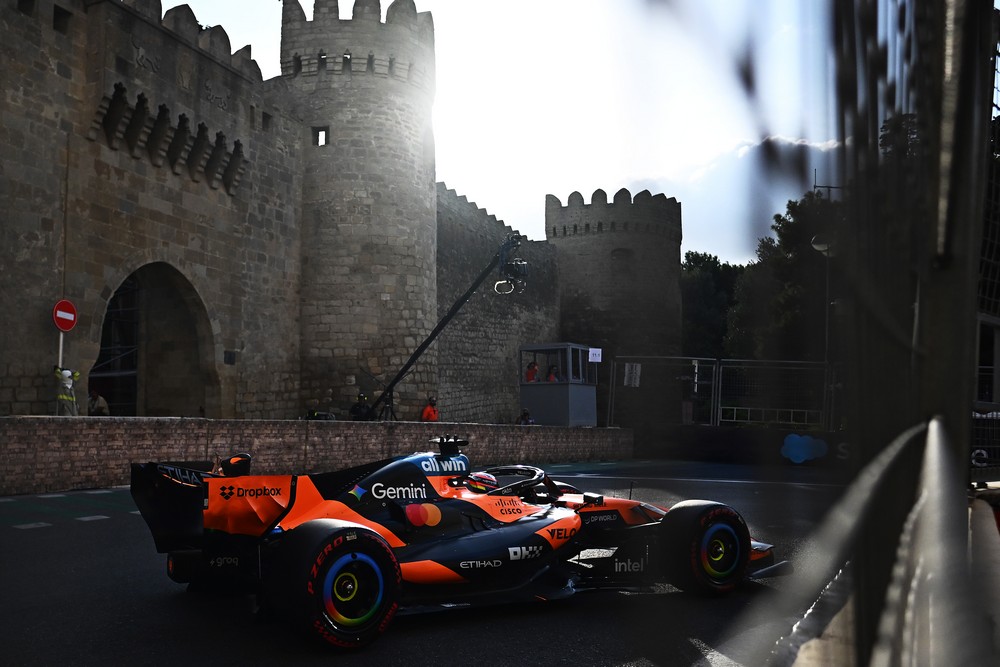
Red Bull retained Isack Hadjar for 2027 onward as part of a long-term deal. The news was announced ahead of the Azerbaijan Grand Prix, the Frenchman’s first race back since injuring his wrist during the summer break. This is his first season with the team, having raced with RB last year, where he earned his first podium. He has had a strong showing with Red Bull this year, scoring points consistently since Canada and earning two podiums in Monaco and Azerbaijan. He will race alongside long-time Red Bull veteran Max Verstappen.
Three-time W Series champion Jamie Chadwick completed a test session with Williams at Portimao. The Portuguese test was part of the team’s Testing of Previous Cars programme, during which she completed 32 laps behind the wheel of the team’s 2025 FW47 car. The 28-year-old currently serves as the team’s ambassador and is an advisor to the Williams Driver Academy’s F1 Academy efforts. Outside of F1, she currently competes in the European Le Mans Series, having won half of the races last season.
Cadillac has expanded its talent pool, hiring three key members of its technical leadership. The first is former Red Bull chief designer Craig Skinner, who will join as the team’s chief development engineer. The role of head of aerodynamics will be filled by former Aston Martin deputy chief Eric Blandin. Experienced aerodynamicist Tim Lean will report to Blandin as the team’s chief engineer of aerodynamics modelling and simulation, having previous experience with McLaren, Red Bull, and Ferrari. All three team members are set to join the team over the next few months in preparation for the US-owned team’s second season.
The F1 Commission approved a reduction in grand prix length for 2027. The total race length will drop by 15km from 305km to 290km, aiding with the power unit changes planned for the upcoming season. Next season’s power units will rely more heavily on internal combustion over electrical power, in response to criticism of the current cars. This requires the cars to consume more fuel. Rather than increase the size of the fuel tanks, which would require teams to spend money on redeveloping their chassis, it was agreed that the race distance would be reduced. The change still needs to be formally approved by the World Motor Sport Council.
The F1 Commission also approved the removal of the three-hour time limit on races. Currently, races can only run for up to two hours, but any red flag will cause the limit to be increased to three hours. The F1 Commission agreed to remove this three-hour limitation in favour of a hard stop time that will ensure the races are still held in the appropriate daylight. Additionally, the F1 Commission has proposed that the race directors should have more freedom to extend free practice sessions that are impacted by red flags. This comes after Lewis Hamilton’s crash during FP3 of the Spanish Grand Prix in Madrid cost nearly 30 minutes of running while the barriers were repaired. The changes will be submitted to the World Motor Sport Council for approval.
Formula One will return to the V8 engines, but retain turbochargers for the next era of engine regulations. Engine manufacturers have been meeting with the FIA to settle on the direction of the new regulations. Although many were in favour of dropping the turbochargers in favour of a naturally aspirated V8, the FIA decided to keep the turbochargers, albeit a smaller version. One of the considerations was sound restrictions at street circuits. The electrical package of the cars will also be significantly simplified and will produce only 100kW compared to the modern 350kW. This will help reduce the costs of power unit development, while still keeping aligned with the current direction of the automotive industry. Finally, the new power units will be at least 50kg lighter than the current specification. It’s unknown when the new engine regulations will be introduced, although it could be as early as 2030.
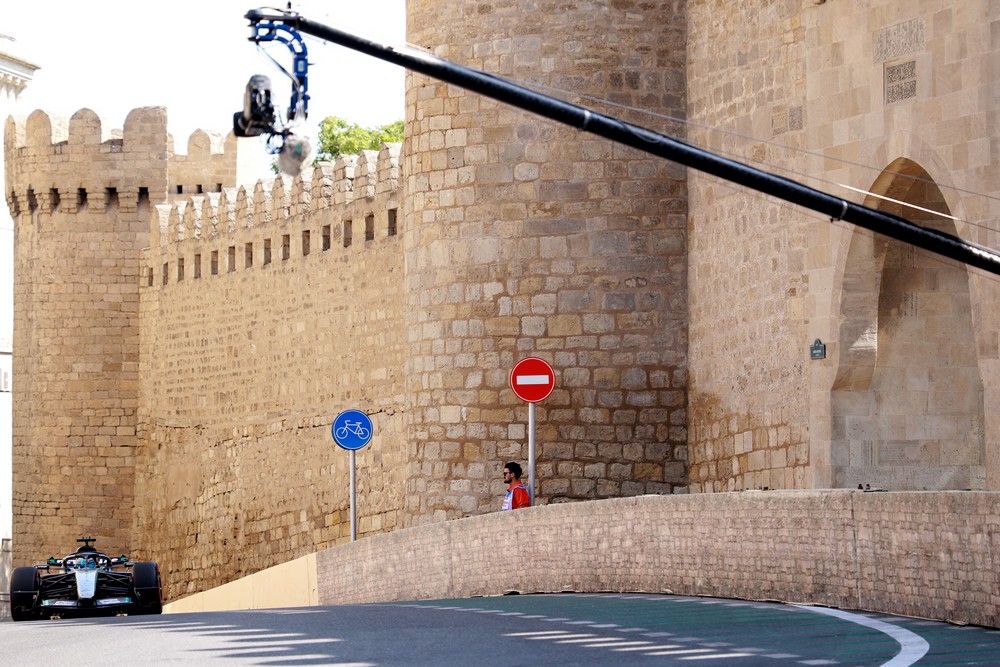
George Russell set the fastest time in the first free practice session of the Azerbaijan Grand Prix weekend, which started on a Thursday. Teammate Kimi Antonelli suffered a hydraulic issue on his Mercedes that forced him to sit out much of the session, although not before setting the fifth-fastest time of the session. Isack Hadjar was another driver who suffered from mechanical woes during his first race back since injuring his wrist during the summer break. A power unit issue severely hampered his running. Max Verstappen was second-fastest in the other Red Bull, narrowly leading the two Ferraris. Oscar Piastri managed only P6, while Lando Norris suffered issues in the other McLaren that saw him finish P14.
George Russell retained his spot on top in the second free practice session. Kimi Antonelli set the second-quickest time, although he was more than half a second off his teammate’s pace. Max Verstappen again led the two Ferraris, although the Dutchman was the only other driver to get within a second of Russell’s pace. The session saw an early red flag when Arvid Lindblad hit the wall at the castle section, damaging his Racing Bulls. Oliver Bearman’s session was also cut short by an engine issue shortly after the resumption of the session. Fernando Alonso also lost out on practice time, fighting an oil leak.
Max Verstappen outpaced George Russell in the final free practice session on Friday morning, setting the fastest time of the session. Less than 0.1s separated the two drivers, with Lewis Hamilton also very close to the pace in P3. Verstappen showed how hard he was pushing, brushing the barriers multiple times around his flying lap. Some drivers pushed a little too hard, as Lance Stroll’s session came to a premature end after he grazed the barrier at the first corner. Kimi Antonelli was fourth fastest ahead of Charles Leclerc, who was ahead of Pierre Gasly in the Alpine.
George Russell took pole position during qualifying, while his teammate had a shocking exit after a Q1 crash. Kimi Antonelli made a costly error in the first corner, clipping the inside barrier at the first corner and damaging the Mercedes suspension. He attempted to make it back to the pit lane, but was instructed by the team to park the car on track. This left Russell to lead all three qualifying sessions, earning pole position by a significant 0.837s margin over Charles Leclerc. The battle for P3 was much closer, with Oscar Piastri losing out by just 0.001s. Lando Norris earned P5 behind Isack Hadjar, who outqualified teammate Max Verstappen, who was down in P8.
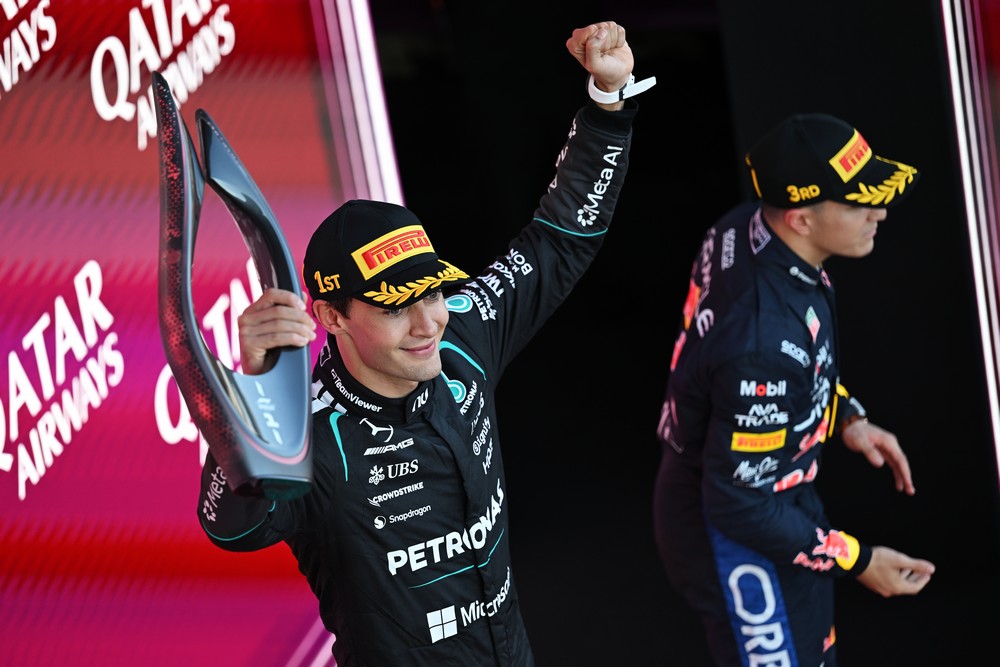
George Russell converted pole into a Saturday race victory at Baku, although it would come down to a drag race to the finish line between him and Max Verstappen. Russell had a good start from pole and immediately started building a gap out front. Both Red Bulls appeared to have much better race pace compared to qualifying, moving up the field, with Isack Hadjar happy to play second fiddle to Max Verstappen. A safety car on lap 30 dramatically changed the course of the race when Alex Albon crashed into the barriers at turn six. This allowed the drivers to pit for tyres and closed the gap to the leading Mercedes. The race resumed only momentarily before Franco Colapinto locked up in the first corner, taking out his teammate and Lando Norris. Oscar Piastri suffered some misfortune in the other McLaren in the closing stages of the race, locking up in the first corner and falling to the back of the field. Verstappen began to pressure Russell in the closing laps. It looked like there would be no opportunity for Verstappen to challenge, but Valtteri Bottas crashed into the barriers at turn 16 on his penultimate lap. Race control opted not to neutralize the race, but going through the yellow flag zone brought the two leaders very close together. Verstappen tried to beat the Mercedes in a drag race to the line, but came up 0.196s short. Teammate Hadjar stood alongside the duo for his second podium appearance of the season. Click here to read a full summary of the race.
Next up, the teams and drivers will head to Malaysia for the Bahrain Grand Prix. The race will be held at the Sepang International Circuit, as the Bahrain Grand Prix was cancelled in the spring due to military conflict in the region. The race will be held on the weekend of October 4.
It can be challenging for even the most avid fans to keep up with the fast-paced world of Formula One. The Weekly F1 Recap is a series published each Monday that breaks down the action, both on and off the circuit, into bit-sized pieces. It's perfect for casual and experienced fans alike.