The proposed track layout for a new American F1 race in Miami have appeared online. Plans for the race will be discussed in an upcoming city meeting, with plans for the first grand prix to be held in the fall of 2019. But is this a suitable place for a race track?
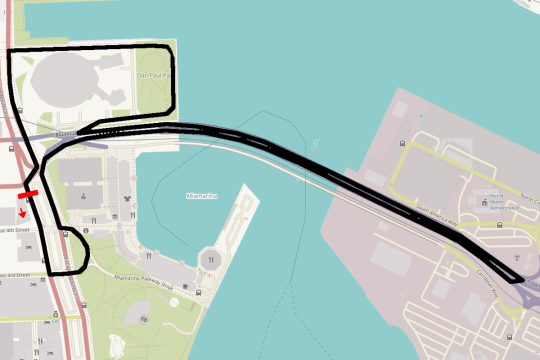
The start/finish line will be located on Biscayne Boulevard and run in anti-clockwise direction. The cars will zoom down the straight into the first near 90 degree corner. They will make a short detour near the shopping malls and rejoin Biscayne heading Northbound instead. From here the drivers will merge into Port Boulevard, the bridge that connects Dodge Island to the mainland. They won’t be on the island for long though, as they will enter a hairpin that will put them heading back in the opposite direction.
Once returning to the mainland, the drivers will take another hairpin corner to get onto Bayshore Drive, where they will drive near the coat and around the American Airlines Arena, the home of the Miami Heat basketball team. They will rejoin Biscayne heading Southbound and jog over to the other lane to conclude the lap.
The longest straight on the circuit could be across the bridge, which could be the longest straight in Formula One. That status is currently shared by Shanghai International Circuit, Baku City Circuit, Yas Marina Circuit and Autodromo Hermanos Rodriguez, each with a maximum straight of 1.2km. Rough measurements puts the longest straight Miami anywhere between 1.2km and 1.3km in length.
First let’s talk about the elephant in the room… it’s another street race. Unfortunately, a big topic of discussion in Formula One has been overtaking… or the lack there of. Street circuits don’t have a very high reputation when it comes to overtaking opportunities and there is always the stigma that street races will be boring because there’s not a lot of overtaking.
Fortunately, the circuit is not particularly narrow. The majority of the circuit is on a three-lane highway, which is wider than many street circuits, such as the tunnel in Monaco which is just two lanes. However, there are a lot of tight turns, including two hairpins and probably 4 near 90 degree corners. This could mean there will be a lot of dives for position or that there will be a lot single-file racing while the drivers navigate through the corners.
Looking at the long straight, this could present a problem as well. Organically, it gives cars with more raw power an advantage, leading to situations in which faster cars and breeze right by competitors with ease. And when you now factor in the DRS zones, which I assume will be located on both straights on the bridge, you have a whole new can of worms.
Not only will the DRS amplify the speed gap between teams, but I also have fears about the DRS detection point. While most tracks have a detection point for each DRS zone, some circuits have two consecutive DRS zones but a single DRS detection point. This is what we see in Hungary, with the DRS detection point in the final corners allowing for DRS down the main straight and then the DRS zone after the first corner. Unfortunately, we could likely see a similar thing at this circuit, with the DRS detection point at the start of the bridge, allowing the car behind to have the DRS open both on the journey to Dodge Island and back to the mainland. This would allow the car behind to overtake and create a sizable gap, giving little to no chance for the other car to dispute the position.
However, even if there is a second DRS detection point after the hairpin, there is still an issue: the drivers would likely use the first DRS zone to catch up to the car ahead, but not overtake, instead waiting until the second zone to overtake and zoom away. That’s again no fun because it minimizes the chance for the car that just got overtaken to fight back. We see this sometimes in Abu Dhabi, which has two consecutive DRS zones with two separate DRS detection points.
I’ve often said that I would love to see the new Formula One cars race at AVUS, a public road that was used for the 1959 German Grand Prix and was basically two 9km straights with a hairpin turn at either end. While I think it would be fun to watch, I don’t think it would provide any entertaining racing, especially not with the DRS in play. Long straights just don’t provide the cool drag races that Formula One fans want to see.
Overall, I’m not a huge fan of the proposed race in Miami. I don’t think that Formula One needs another American race and we are certainly not in the market for another street circuit. There have been some previous street circuits in the United States, such as Long Beach and Phoenix, both of which had some success. Unfortunately, I don’t think that the newer cars would see quite the same entertainment at these circuits (yes, I realize the irony of saying this just a week after we had a spectacular race in Azerbaijan).
The views and opinions expressed in this article are solely those of the author and do not necessarily reflect the official policy or position of any other agency, organization, employer or company. Assumptions made in any analysis contained within this article are not reflective of the position of any entity other than the author.